


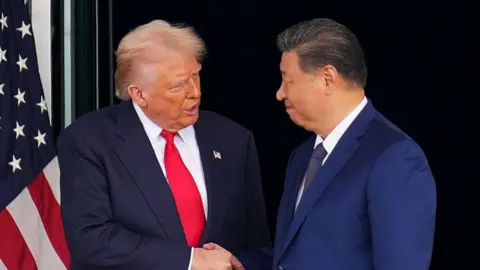
Presidential journeys abroad have typically been an opportunity to showcase the power of the US on the world stage. Trump's week-long swing through eastern Asia, conversely, has been a display of the clout of the leader – but also, at times, of that power's constraints.
Trump's destinations in Malaysia, Japan and South Korea over the duration of the initial days were an exercise in pleasing a occasionally mercurial president. It was an recognition that the leader, with the stroke of a pen, could enact tariffs and further steps that have the ability to devastate the financial systems of export-dependent states.
His discussion with Chinese leader Xi on the last day, nevertheless, was a distinct situation.
It was a meeting of equals on the international scene, where the consequences for both nations – for their financial health, for their global standing, for the prosperity of their people – were enormous.
With China, Trump may wave his authority, but such actions come with consequences. They come with a cost.
- The US president describes 'amazing' meeting with the Chinese leader but no trade deal agreed
- Xi and the US leader establish short-term ceasefire as China pursues extended strategy
For the initial phase, the president's recent entry into world politics was uneventful.
Each visit was characterized by a blend of traditional commercial discussions – agreements made under the shadow of Trump's "mutual" tariffs – and personal accommodations that at points approached the deferential.
In the Malaysian stop, the president obtained access to critical minerals and made headway toward completing economic agreements with regional partners. He also oversaw a treaty that should alleviate territorial disputes between Thailand and Cambodia – the sort of "peace deal" the US leader loves to tout.
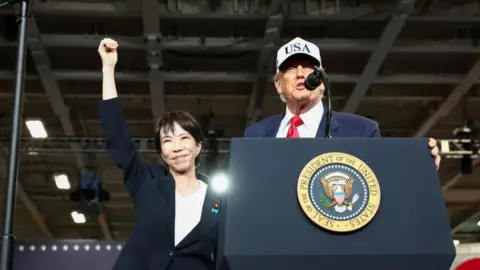
In the Japanese leg, Trump's official aircraft passed by a Tokyo Tower displayed red, white and blue – with a top in Trumpian gold.
Freshly appointed Head the Japanese leader described $half-trillion in Japan's financial commitments in the United States and offered the American president a present of 250 flowering trees for America's semiquincentennial, and a sports gear and carrier that came from Shinzo Abe, the murdered ex-leader who developed ties with Trump in his previous administration.
She also became the latest foreign leader to suggest the president for his much-desired Nobel Peace Prize.
Keeping pace, South Korea greeted Trump with guns firing a honor salute and a service ensemble that performed the leader's song and the Village People song – the Village People anthem that has turned into a Trump rally standard.
Leader the Korean president held an "honour ceremony" for the US leader during which he presented the American leader his nation's highest medal and a model of an historical royal headpiece.
Noon repast with Lee included a "Conciliatory Treat" of gold-covered brownies. Subsequently, the South Koreans served Trump fine beverage at an private meal in the president's honor with six world leaders participating in the Asia-Pacific Economic Conference meeting.
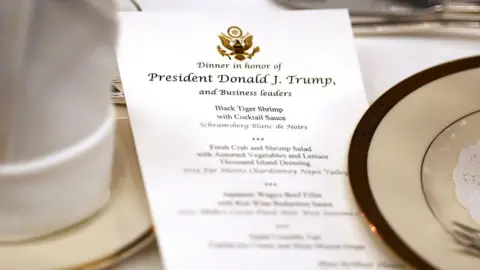
In the America, the president may be the target of "Anti-Authority" protests by the public who reject his limit-pushing extensions of leader's control, but during his Asian swing he was received as monarchy.
And like the rulers of old, Trump arrived in the Korean nation demanding payment – in the shape of $two hundred billion in monetary contributions, $20bn a year, from the host nation to the United States, to be invested at the discretion of Trump's government. Consent on the terms of those contributions assisted in that the tariff rate on Korean exports to the America would decrease from a quarter to fifteen percent.
The main event of Trump's Asian tour came in its final hours, however, as he met with the Chinese leader.
At that location, the power dynamic between leaders of the planet's biggest economic powers was noticeably different than the meetings Trump had with his overseas colleagues in prior visits.
Not present were the usual pageantry and the pageantry. Without any service ensembles, without ceremonial troops, missing thoughtfully prepared dining selections marking bilateral friendship. By contrast, the both heads and their senior advisors were seated across a long white negotiating table in a unremarkable service structure just adjacent to the landing strip of the city of Busan's air transport hub.
It was perhaps a reflection of the significant risks that when Trump made contact with Xi in the southern port, he looked


